Seller software in 2026–2027: Five Predictions That Will Reshape the Market
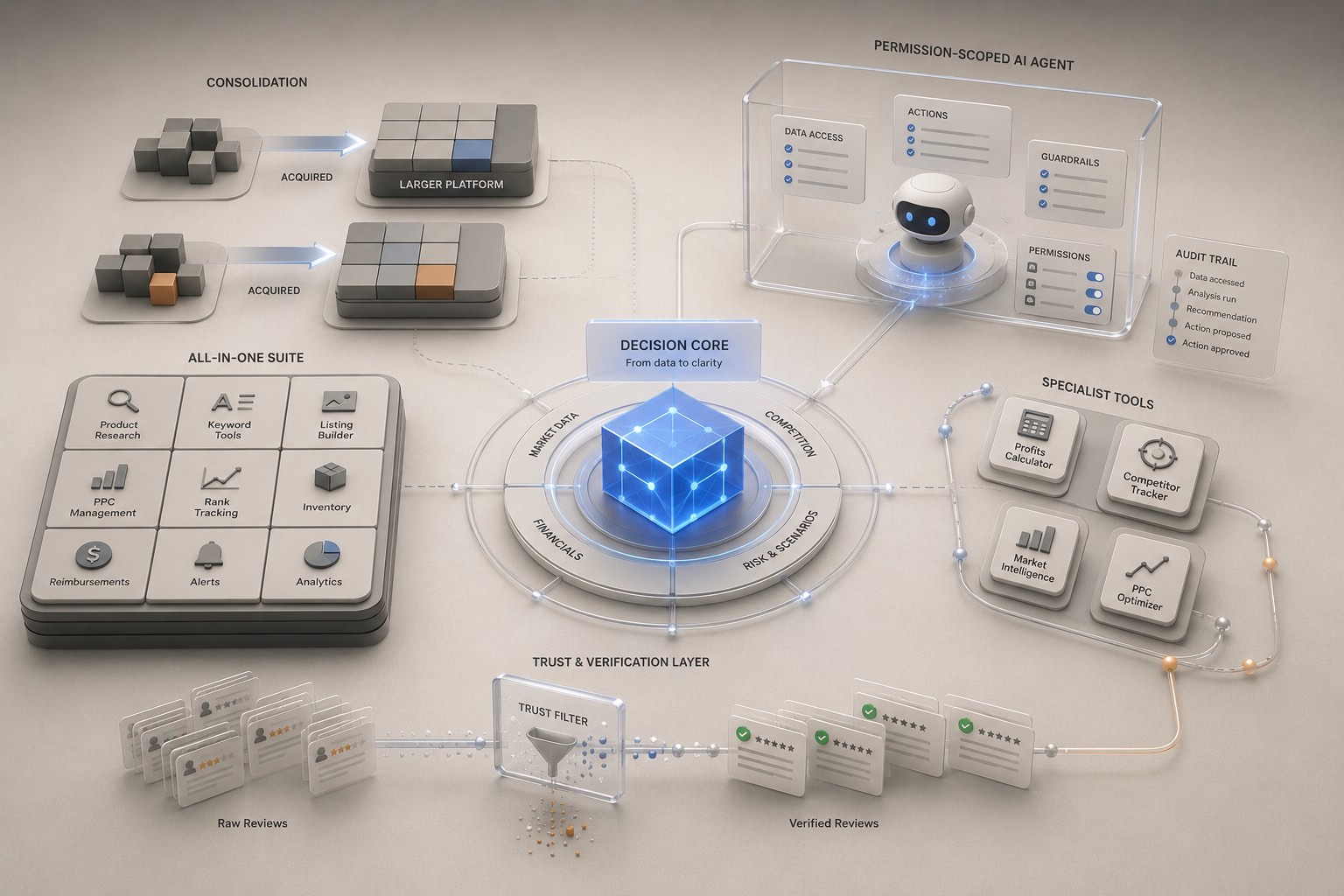
Seller Software in 2026–2027: Five Predictions That Will Reshape the Market
For most of the past decade, Amazon seller software competed on feature count.
One platform added a keyword tracker. Another responded with a listing builder, reimbursement module, inventory planner, PPC dashboard and AI assistant. Pricing pages became longer, interfaces became denser, and sellers accumulated subscriptions they only partially used.
That era is ending.
As of July 2026, the seller software market is moving away from dashboards that merely display more data and toward systems that help users make—or safely execute—specific business decisions.
The next generation of winners will not necessarily have the longest feature list. They will be the products that can answer questions such as:
* Should we enter this niche?
* How much inventory can we safely order?
* Which advertising changes can be made without exceeding our target margin?
* Which competitor movement requires action?
* Can this recommendation be verified?
* What exactly did the AI change, and why?
Here are five predictions from the TrustMatch editorial team for where the seller software market goes next.
Prediction 1: At least two more mid-sized seller tools will be acquired before the end of 2027
Consolidation in seller software is no longer theoretical.
In February 2025, retail supply-chain software company SPS Commerce completed its acquisition of Carbon6, a provider of Amazon seller tools, for approximately $210 million. Carbon6 had built a portfolio around functions such as revenue recovery and operational support for first- and third-party Amazon suppliers. (SPS Commerce, Inc.)
The transaction demonstrated that seller software can be strategically valuable to companies operating outside the traditional Amazon-tool ecosystem. Supply-chain platforms, retail media companies, payment providers, logistics businesses and enterprise commerce platforms can all benefit from owning seller relationships and marketplace data.
Earlier consolidation created a similar structure around Pacvue and Helium 10. Pacvue’s parent company integrated the enterprise-focused Pacvue platform with Helium 10’s seller-facing ecosystem, combining marketplace operations, advertising and seller analytics under a broader commerce technology group. (Pacvue)
Our prediction is that at least two additional mid-sized seller software businesses will be acquired before 2027 ends.
The most attractive targets will not necessarily be the tools with the most users. Buyers will look for companies that own one of four assets:
1. A proprietary or difficult-to-reproduce dataset.
2. A workflow that sellers use every day.
3. Permissioned access to operational marketplace accounts.
4. A direct connection between software usage and measurable financial results.
Revenue recovery, PPC execution, inventory forecasting, marketplace finance and product validation are especially acquisition-friendly categories because their value can be connected to money saved, revenue generated or risk avoided.
Standalone tools with useful features but weak retention will struggle. Products that become part of a seller’s operating process will command more attention.
Prediction 2: AI agents will mature from chat interfaces into audited workers
Adding a chatbot to a dashboard was enough to claim an AI strategy in 2024 and 2025.
It will not be enough in 2027.
Amazon has already moved beyond simple conversational assistance. Its Seller Assistant can reason, plan and, with the seller’s permission, take actions related to inventory, account health and business operations. Amazon reported that the assistant had more than 230,000 monthly users in 2025 and that sellers accepted its recommended actions more than 90% of the time. (Amazon News)
In March 2026, Amazon expanded the system with dynamic canvases that generate personalized visual workspaces using real-time seller data, scenario analysis and recommended actions. (Amazon News)
Amazon Ads is following the same direction. Ads Agent can create campaign structures, adjust pacing across multiple campaigns, recommend audiences and generate Amazon Marketing Cloud queries. Importantly, proposed changes are summarized for the advertiser and applied only after review and approval. (Amazon Ads)
Third-party platforms are also rebuilding around agent-native access. Pacvue, for example, now offers an MCP-based access layer that allows approved AI systems to retrieve retail-media data while respecting existing configurations and permissions. (Pacvue)
This tells us what seller AI will look like in 2027.
The serious products will have:
* clearly defined permission scopes;
* approval thresholds for financial or operational actions;
* logs showing what the agent viewed, recommended and changed;
* explanations tied to source data;
* the ability to reverse or reject actions;
* separate permissions for employees, agencies and external contractors;
* rules limiting the agent by SKU, marketplace, budget or account.
An AI agent that can change an advertising budget is more valuable than a chatbot that explains ACoS. It is also more dangerous.
That is why auditability will become a product feature, not merely a compliance requirement.
Sellers will increasingly ask: “What can this agent do without me?” The best platforms will answer that question precisely.
Prediction 3: Specialist tools will continue taking share from traditional all-in-one suites
All-in-one suites are not disappearing. Established brands managing large catalogs, multiple marketplaces and sophisticated PPC operations still benefit from broad platforms.
But the economic advantage of bundling dozens of basic features is weakening.
Amazon itself continues to add free or native functionality. Its seller tools now cover listing creation, business management, advertising controls, product-opportunity analysis and AI-powered recommendations. Opportunity Explorer, for example, has evolved from presenting raw search and purchase signals into generating recommendations based on large volumes of customer interaction data. (Amazon News)
As the marketplace provides more basic functionality, third-party platforms cannot rely on features that Amazon can reproduce and distribute inside Seller Central.
Specialist tools have a different opportunity.
Instead of trying to manage the entire Amazon business, they can own one high-value decision:
* whether to launch a product;
* how much inventory to purchase;
* when to increase or reduce a bid;
* which reimbursements to claim;
* how to interpret customer complaints;
* when a competitor’s movement changes the economics of a niche.
A focused product can build a deeper workflow, clearer user experience and more relevant AI context around that decision than a general-purpose suite.
The important distinction is that “specialist” does not necessarily mean “single-feature.”
A modern specialist platform may include research, tracking, calculations and AI. What makes it specialized is that all those capabilities serve one connected outcome.
The category will therefore split into three layers:
Marketplace-native tools
Amazon will continue expanding the free functionality available inside Seller Central.
Broad operating suites
Platforms such as Helium 10 and Pacvue will remain relevant for sellers and brands that need extensive coverage across advertising, operations, research and multiple channels.
Decision-specific workspaces
Focused platforms will combine the data and tools needed to solve a narrower problem better than a broad suite.
This third layer is where much of the new product innovation will happen.
Prediction 4: Review platforms will face much stronger pressure to verify what they publish
This pressure is necessary.
Generative AI has made it inexpensive to produce convincing reviews at scale. Research published in 2025 found that human participants identified AI-generated fake product reviews with accuracy close to random chance. The researchers concluded that review systems increasingly need trustworthy transaction or experience verification rather than relying mainly on textual detection. (arXiv)
Regulators are reaching the same conclusion.
The US Federal Trade Commission’s Consumer Review Rule came into effect in October 2024. It prohibits several forms of fake and deceptive reviews and allows civil penalties for knowing violations. In December 2025, the FTC warned ten companies about possible violations of the rule. (Federal Trade Commission)
The UK introduced additional obligations in April 2025. Businesses that publish consumer reviews must take reasonable and proportionate steps to prevent and remove fake reviews, concealed incentivized reviews and misleading review information. In March 2026, the Competition and Markets Authority announced investigations into five businesses over potentially fake or misleading review practices. (GOV.UK)
The scale of the problem is significant. Trustpilot reported removing 4.5 million detected fake reviews submitted during 2024, equivalent to 7.4% of all reviews submitted that year. (Trustpilot)
By 2027, displaying reviews without explaining their origin will become increasingly difficult to defend.
Review platforms should expect pressure to introduce:
* verified-user and verified-customer labels;
* proof that a reviewer used or purchased the product;
* clear identification of incentivized reviews;
* conflict-of-interest declarations;
* visible moderation and appeals policies;
* public explanations of rating calculations;
* separation between editorial evaluations and user reviews;
* warnings when unusual review patterns are detected;
* clearer disclosure of commercial relationships with reviewed companies.
Verification should not mean that only paying customers can express an opinion. A user may have legitimately tested a product through a trial, worked with it at an agency or evaluated it during a procurement process.
But the platform should communicate what has actually been verified.
For TrustMatch and similar platforms, this is an opportunity rather than merely an obligation. Stronger verification increases operating costs, but it also makes the resulting ratings more useful and defensible.
A platform that can say “this review came from a verified user with a confirmed product experience” will be more valuable than one that simply displays another anonymous five-star score.
Prediction 5: Mettra will either define the launch-validation category—or become an acquisition target trying
One of the more interesting emerging categories is product launch validation.
Traditional Amazon software usually separates product research, competitor tracking, financial calculations and AI analysis into different modules. The seller collects data in one tool, exports it into a spreadsheet, checks historical movements elsewhere and then asks another system to interpret the results.
Mettra is taking a different approach.
The platform combines Amazon product and niche analysis, competitor tracking, a structured financial model, a browser extension and a context-aware AI assistant. Its positioning is built around one central outcome: helping sellers decide whether a product opportunity is commercially strong enough to launch. (Mettra)
That makes Mettra more than another product-research interface. It is attempting to create a dedicated workspace for the stage between discovering an idea and committing capital to inventory.
This is strategically attractive because launch validation sits at a critical point in the seller lifecycle.
A bad keyword decision may waste part of an advertising budget. A bad launch decision can lock tens or hundreds of thousands of dollars into inventory, logistics, packaging and marketing before meaningful demand has been proven.
Mettra has two possible paths.
Path one: It becomes the category standard
To achieve this, Mettra must turn launch validation into a recognizable, repeatable workflow.
That means sellers should be able to move through a consistent process:
1. Identify a niche.
2. Measure demand and competitive pressure.
3. analyze historical market behavior.
4. Build complete unit economics.
5. Model adverse scenarios.
6. Monitor selected competitors.
7. Receive a clear, explainable launch assessment.
If that workflow becomes widely adopted, “run it through Mettra” could become a standard step before ordering inventory—similar to how certain established tools became synonymous with keyword research or historical price tracking.
Path two: It becomes an acquisition target
Mettra could also become attractive to a larger seller suite, marketplace intelligence provider, financing company or retail operating platform.
The strategic value would not come from any individual calculator or chart. It would come from owning the decision layer between product discovery and capital deployment.
A financing provider could use structured launch analysis to improve underwriting. An all-in-one suite could use it to strengthen product research. A supply-chain platform could connect validation directly to sourcing and inventory planning.
The biggest risks are equally clear.
Amazon may continue improving its own Opportunity Explorer. Existing suites may bundle similar AI validation features. And any product making launch recommendations must continuously prove that its underlying data and conclusions are accurate enough to support real financial decisions.
Mettra does not need to match every feature offered by established suites. It needs to become exceptionally trusted at one job: determining whether a seller should enter a market and under what financial conditions.
That is a narrower ambition—but potentially a more defensible one.
What seller software buyers should evaluate now
The buying criteria for seller software are changing.
Before purchasing or renewing a platform in 2026–2027, sellers should ask:
What decision does this product improve?
“More analytics” is not a sufficient answer. The product should help improve a specific commercial decision or operational outcome.
Can the data source and methodology be explained?
A sales estimate or AI recommendation is only useful when the seller understands where it came from, how recently it was updated and what assumptions it contains.
Does the software understand profitability?
Revenue, BSR and search volume do not show whether a product is economically viable. Strong platforms will connect market signals to fees, advertising costs, logistics, returns and contribution margin.
Can its AI act, or does it only talk?
A conversational interface may save time, but the larger value comes from safely executing approved workflows.
Are AI actions permissioned and auditable?
Sellers should be able to see exactly which data the agent accessed, what it recommended, what it changed and who approved the action.
How much of the subscription is actually used?
A suite with 30 features is not necessarily better value than a focused platform with five tightly connected capabilities.
Can the result be verified?
Whether the platform produces a product score, software rating or PPC recommendation, users need a way to inspect the supporting evidence.
The market is moving from software access to decision confidence
The previous generation of seller software sold access to information.
The next generation will sell confidence:
* confidence that a product is worth launching;
* confidence that an advertising action stays within margin targets;
* confidence that an AI agent has not exceeded its authority;
* confidence that a review came from a real experience;
* confidence that the data behind a recommendation can be inspected.
The biggest suites will not disappear. Some will become broader through acquisitions. Others will add agentic interfaces and deeper automation.
But feature count will become a weaker measure of product value.
Sellers are no longer impressed by another dashboard tab. They want fewer disconnected metrics, fewer manual exports and fewer subscriptions that overlap.
They want software that reaches a conclusion, explains it and helps them act safely.
Whatever happens to individual companies, the direction is clear:
Sellers are done paying for features. They are paying for better decisions.