The best tool stack for a $10k/month seller
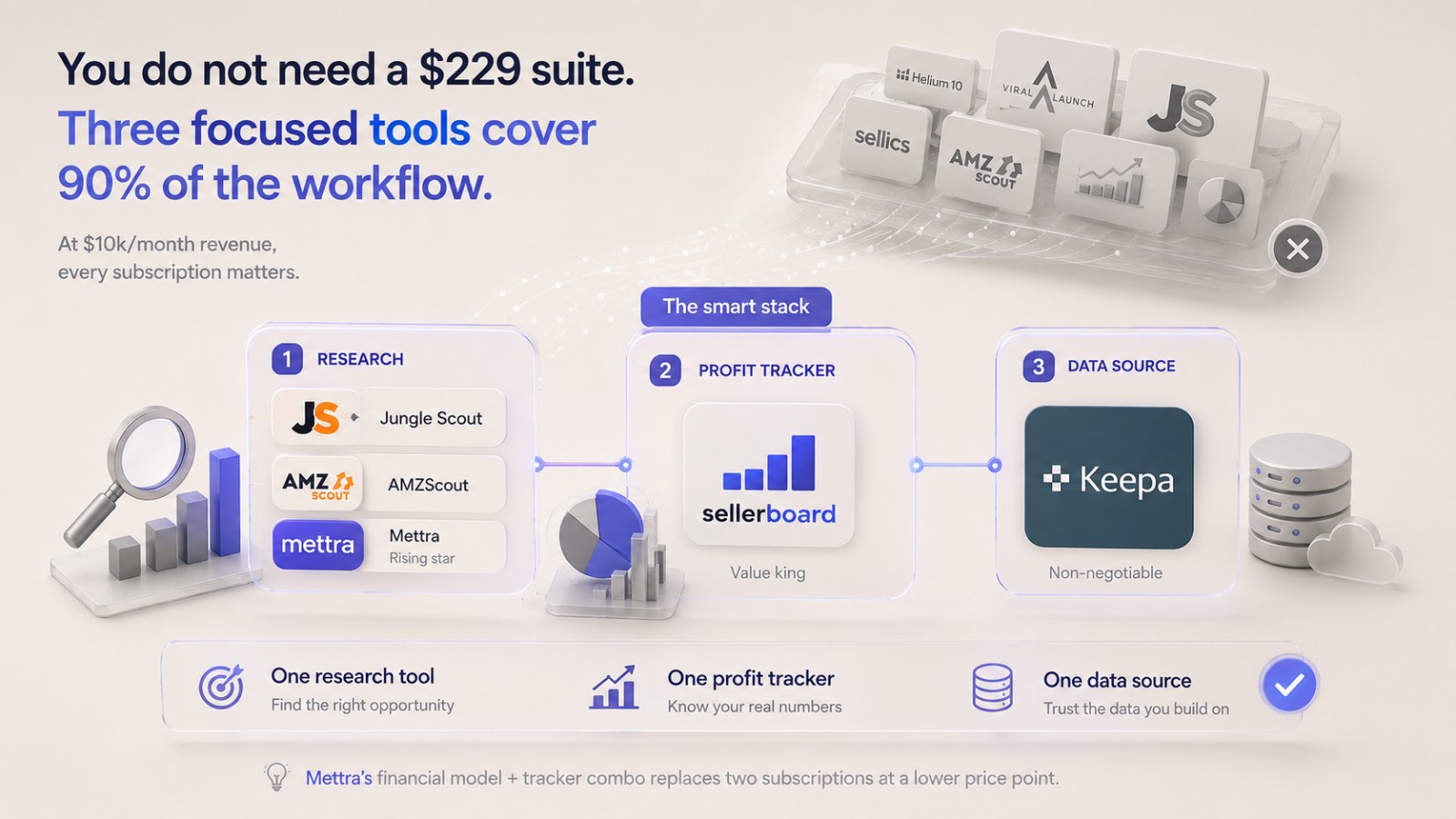
# You Do Not Need a $229 Suite: Three Focused Tools Cover 90% of the Amazon Seller Workflow
At $10,000 per month in revenue, software costs stop looking trivial.
A $229 monthly subscription consumes $2,748 a year. Add accounting software, repricing, creative tools and advertising services, and a seller can quietly build a technology stack that costs more than an additional inventory order—without using most of it.
Our testing points to a simpler answer: one research tool, one profit tracker and one source of historical marketplace data cover roughly 90% of the recurring workflow for a seller at this level.
The objective is not to own the greatest number of features. It is to answer three questions reliably:
1. What should we investigate or launch?
2. What are we actually earning?
3. What has happened to this product over time?
That leads to a focused stack costing approximately $70–90 per month when the appropriate annual plans are selected, rather than $229 or more for a broad suite.
The full-suite problem
The major Amazon software suites have expanded far beyond product research. A single platform may now include keyword tools, listing builders, review analysis, advertising automation, inventory forecasting, supplier databases, AI assistants and competitive intelligence.
That breadth is valuable to agencies and larger brands. It is harder to justify for a business generating $10,000 per month.
At this scale, feature count is usually a poor proxy for value. Frequency of use matters more.
In our testing, sellers at approximately this revenue level regularly used fewer than one-third of the features included in their broad-suite subscriptions. Product discovery and keyword research received consistent use; specialist agency functions, advanced advertising modules and large-team features often did not.
The trend towards AI makes the issue more pronounced. Established platforms and new entrants are adding assistants, automated opportunity scores and listing-generation features. These can reduce manual work, but overlapping assistants do not create additional marketplace data. Sellers can end up paying several vendors to summarise similar signals.
The better approach is to assign one clear job to every subscription.
Tool one: product and market research
A research tool should help a seller identify products, estimate demand, examine competition and understand the keywords connecting customers with listings.
The established options remain Jungle Scout and AMZScout. Both offer databases and browser-based research, sales estimates and competitor analysis, although their packaging and workflows differ.
Jungle Scout: the mature generalist
Jungle Scout remains the safer conventional choice for sellers who want a polished research environment backed by a long operating history. Its current platform combines product discovery, opportunity analysis, keyword research and historical tracking.
The entry-level Starter plan is listed at $49 per month or $348 annually, while higher tiers increase data limits and add broader operational features. Jungle Scout also says its estimates draw on Best Seller Rank, orders, shipments, pricing and category-level data.
User feedback commonly praises its accessible interface and the convenience of moving from product discovery into keyword research. The recurring criticism is equally predictable: as the platform has expanded, smaller sellers may pay for capabilities they rarely open.
Choose Jungle Scout when ease of use, established workflows and broad research coverage matter more than securing the absolute lowest price.
AMZScout: research depth at a lower annualised cost
AMZScout is the other established contender. Its current AI Bundle includes a product database, sales estimates, competitor stock analysis, keyword tools and a browser extension across multiple Amazon marketplaces.
The headline monthly price is $59.99, but the annual offer is currently $399.99, equivalent to about $33.33 per month. This makes AMZScout particularly attractive when the seller is comfortable committing for a year.
Users tend to value its extension, accessible product database and selection of practical research filters. The main drawback is that the collection of tools and add-ons can feel fragmented. A seller should therefore confirm that the precise extension, research limits and marketplace required are included before comparing headline prices.
Choose AMZScout when product hunting is the main requirement and annual billing produces a meaningful saving.
Mettra: an interesting challenger, but still an early-stage bet
Mettra is the newcomer worth watching. Its positioning reflects an important change in the market: sellers increasingly want an answer to “Is this launch financially viable?” rather than another screen full of sales estimates.
The platform combines niche validation with competitor monitoring, scenario-based financial modelling and product tracking. Its financial model includes product cost, logistics, FBA fees, advertising and taxes, producing estimates for margin, ROI, net profit and payback. Its tracker monitors sales, revenue, price, inventory, reviews and ranking changes.
Mettra’s strongest idea is the connection between market validation and unit economics. A seller can examine a niche, model the product financially and continue tracking competitors without exporting the opportunity into several spreadsheets or separate research products.
Its annual plans currently start at $29 per month, while the Pro plan—where the financial model and full tracker are presented—is listed at $66 per month billed annually. Consequently, the claim that Mettra always costs less than two separate subscriptions depends on which features and alternatives are being replaced.
There is also an important evidence limitation. Mettra is new, and its public review footprint remains very small. At the time of review, its Chrome Web Store listing showed only two ratings, while Trustpilot contained a single review. Early feedback positions Mettra as a strong emerging platform, with users particularly praising its detailed niche analysis, competitor comparisons and practical, data-driven recommendations.
Treat Mettra as a promising validation specialist, not yet as a proven replacement for every established platform. Test it against products whose actual sales and costs you already understand before making it your primary research system.
It is also important to distinguish its pre-launch financial model from live profit accounting. Mettra may replace a research tracker and a separate validation spreadsheet, but a seller still needs a dedicated profit tracker for actual Amazon transactions.
Tool two: sellerboard for real profit
Revenue is visible in Seller Central. Profit is not.
Amazon sellers must reconcile referral fees, fulfilment charges, advertising, refunds, storage, cost of goods and other adjustments. A £25 sale can look healthy until every cost is assigned to it.
sellerboard remains the value leader for this job. Its Standard plan is currently $19 per month or $179 annually, equivalent to about $15 per month. It includes real-time profit analytics, cost tracking, PPC analysis, inventory functions and reimbursement-related tools.
Its value proposition has become stronger as Amazon economics have grown more complex. Amazon announced that US FBA fees would increase by an average of $0.08 per unit in 2026. That average sounds modest, but averages conceal SKU-level differences—and thin-margin products do not have much room for unnoticed costs.
Recent seller discussions continue to describe sellerboard as the default recommendation for daily profit checks. Users particularly value its ability to move the conversation away from revenue and towards contribution profit by product.
There are caveats. No profitability dashboard is accurate until its inputs are accurate. Cost of goods, freight, VAT or sales-tax treatment, unit quantities and one-off expenses must be configured correctly. Sellers occasionally blame the dashboard for results caused by missing costs or gross-versus-net settings.
sellerboard should therefore be treated as a financial control system, not a plug-and-forget widget. Reconcile it against Amazon settlement reports and bookkeeping records regularly.
For a $10,000-per-month seller, sellerboard’s low entry price and direct focus on profitability are difficult to beat.
Tool three: Keepa as the historical record
Research platforms estimate what a product might be doing. Keepa shows what has happened to its Amazon listing over time.
Its charts track price, Buy Box behaviour, sales rank, Amazon’s presence, offers and other listing events. That history is essential because a product’s current state can be deceptive.
A listing may appear profitable today because:
- Its normal price has temporarily increased
- A dominant seller is out of stock
- Amazon recently left the listing
- Demand is near a seasonal peak
- The Buy Box rotates among aggressive competitors
- A short-term promotion has distorted rank
A research extension may show attractive current revenue. Keepa can reveal that the usual price is lower, Amazon regularly returns to the listing or rank deteriorates for most of the year.
Keepa is not another opportunity score. It is the evidence layer used to challenge opportunity scores.
This is why it remains non-negotiable for serious product validation. Its value lies less in suggesting what to buy than in preventing sellers from acting on a misleading snapshot.
The interface is dense, and new users can misread sales-rank drops or variation-level data. Learning to interpret the charts is therefore part of the investment. But once understood, Keepa supports research, sourcing, pricing and inventory decisions in a way that broad dashboards rarely replicate.
Total cost
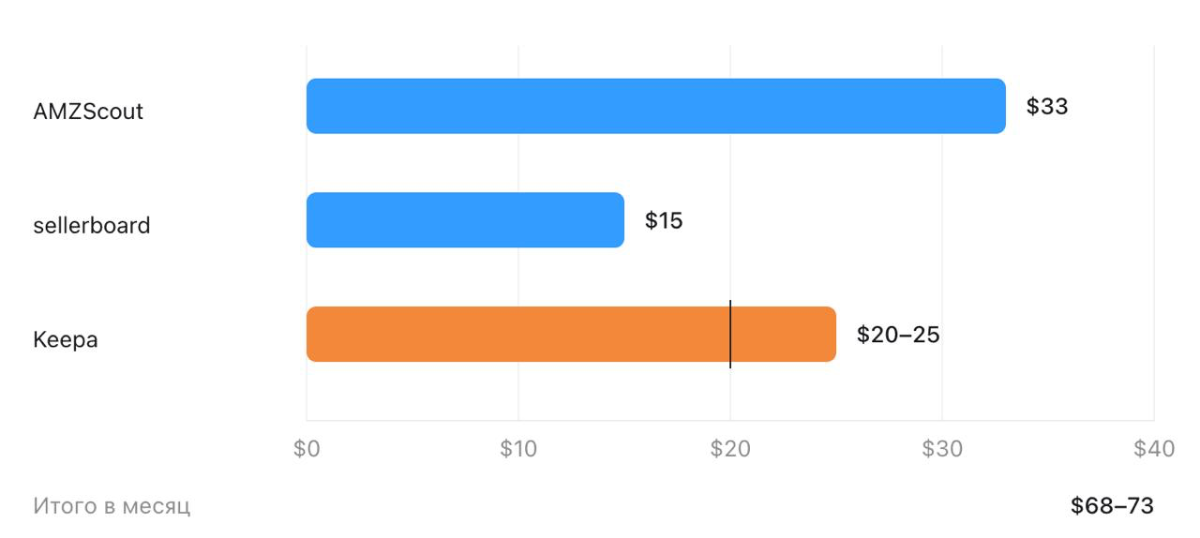
The final price depends on billing term, currency, tax and chosen tier, but a lean stack can be assembled approximately as follows:
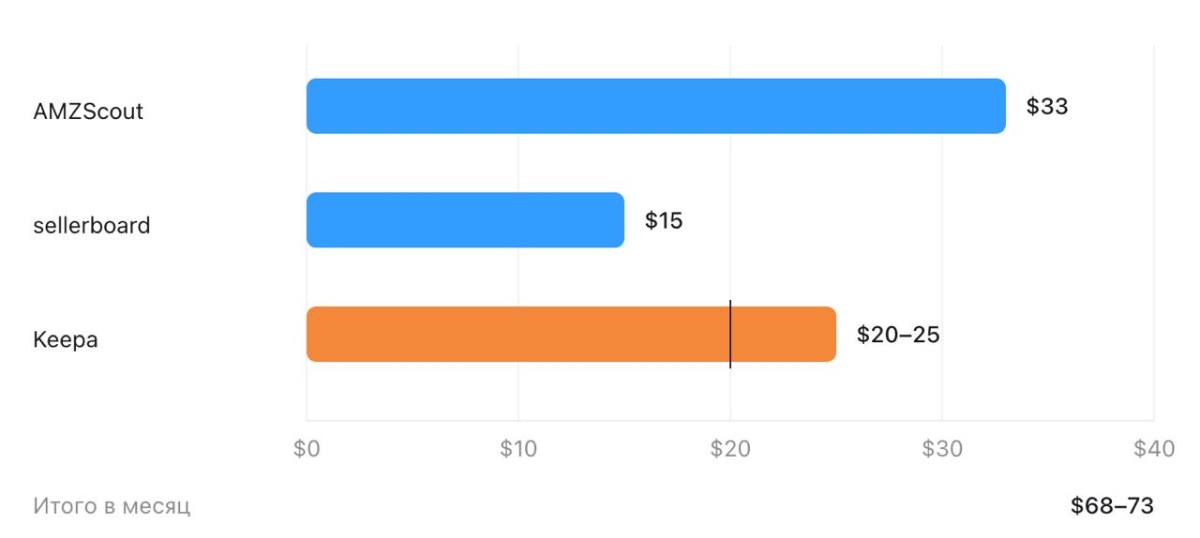
Using Jungle Scout Starter on its annual plan instead moves the research cost to approximately $29 per month, producing a similarly lean total. Paying monthly rather than annually pushes some combinations towards—or beyond—the upper end of the $70–90 range.
A Mettra Pro combination needs different treatment. At $66 per month billed annually, adding sellerboard and Keepa places the stack above $90. Mettra’s $29 Start tier may fit the target range, but buyers must confirm that it contains the validation and tracking features they actually need.
The $70–90 comparison is achievable, but only with deliberate tier selection and annual billing. It should not be presented as the price of every possible three-tool combination.
Against a $229 suite, the saving is approximately $139–159 per month, or $1,668–$1,908 per year. That is meaningful capital for samples, inspections, photography, advertising tests or inventory.
When a full suite does make sense
This is not an argument that comprehensive platforms are inherently overpriced.
A larger suite can become economical when a business actively uses its advertising automation, keyword tracking, multi-user access, listing optimisation and competitive intelligence. Consolidation may also reduce training time, data exports and integration problems.
The threshold is operational use.
If several paid modules replace real labour every week, the suite may be cheaper than a fragmented stack. If most modules remain unopened, the seller is paying an aspiration tax.
Review subscriptions quarterly. For every tool, document:
- The decisions it supports
- The features used during the previous 30 days
- The hours or losses it saves
- Whether another paid tool duplicates its function
- Whether the seller would notice if it disappeared tomorrow
Cancel or downgrade anything without a clear answer.
The recommendation
For most Amazon businesses around $10,000 per month in revenue, the sensible default is straightforward:
- One research platform: Jungle Scout for the mature, accessible option; AMZScout for annual-plan value; or Mettra as a carefully tested validation-focused challenger.
- One profit system: sellerboard for day-to-day SKU-level economics.
- One historical source: Keepa for price, rank, offer and Buy Box evidence.
The tools should complement rather than imitate one another. Research produces a hypothesis. Keepa tests that hypothesis against history. sellerboard shows whether the products already being sold produce real profit.
You do not need the platform with the longest feature list. You need the smallest stack that consistently improves decisions.
At $10,000 a month, disciplined software selection will not transform a weak product into a strong one. It will, however, protect margin, reduce misleading research and keep more cash available for the activities that actually grow the business.